When Kira was seven years old, she started shaking. It took multiple false diagnoses before doctors finally landed on Essential Tremor (ET), a progressive neurological disorder that causes tremors in the hands, head, arms, legs, and voice. At the time, she and her family were told that ET was very rare in children. But, as Kira explained, nowadays, it’s more common.
Today, Kira’s tremors are mostly in her hands but, over the last five years, they’ve progressed to her head. She also experiences several non-motor symptoms, like severe anxiety, generalized and social. “The social anxiety comes,” she said, “from living so long with stares from strangers and questions from everyone I meet.” She also experiences sleep dysregulation and drug-induced lupus symptoms from the medication she’s been prescribed. She explained, “These symptoms include, but definitely aren’t limited to, foggy headaches, extreme fatigue, facial rashes, muscle weakness, digestive disorders, hair loss, memory loss, photosensitivity, and temperature intolerance.”
When I asked Kira how ET has affected her work, she teased, “I may have picked one of the worst careers for someone with ET. Being a touring musician is exhausting for the average Joe but doing it with ET is quite challenging.” There have been times when she couldn’t play her guitar, and times when she couldn’t even get on stage. “Unfortunately,” she said, “alcohol is ever-present in my line of work and, for way too long, I relied on it when the medication wasn’t doing its job. I’d pay the price in the following days and weeks, which started a vicious cycle of which I now care to have no part.”
But it’s more than her work. “Essential tremor,” she said, “has impacted my life more than I realized. From the smallest thing like avoiding dinners with new people (so that no one will watch my hands as I struggle to get the fork from the plate to my mouth), to big things like not being able to dress myself without assistance. All of my relationships are affected by ET because all of my life is affected. Until my surgery, ET and its effects dictated 98% of my decisions.”

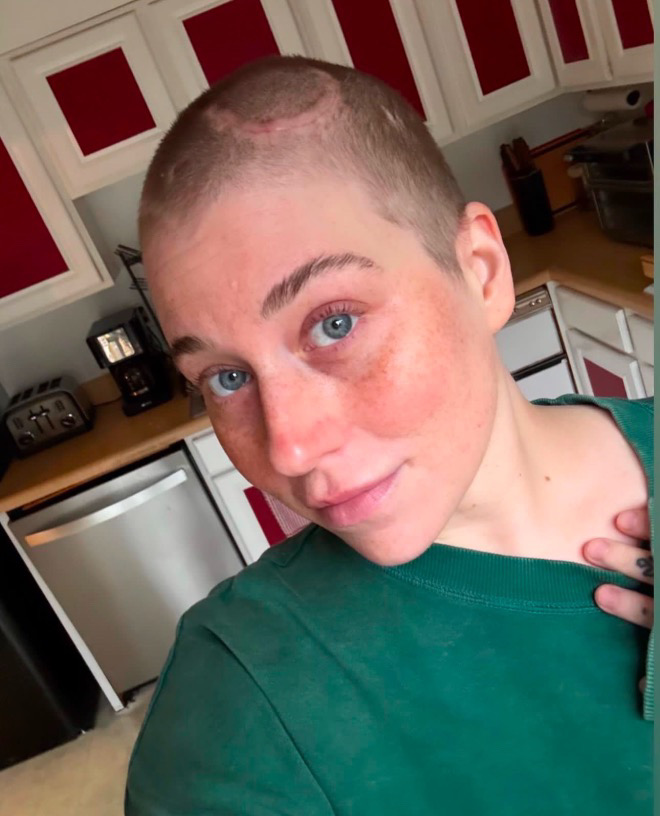
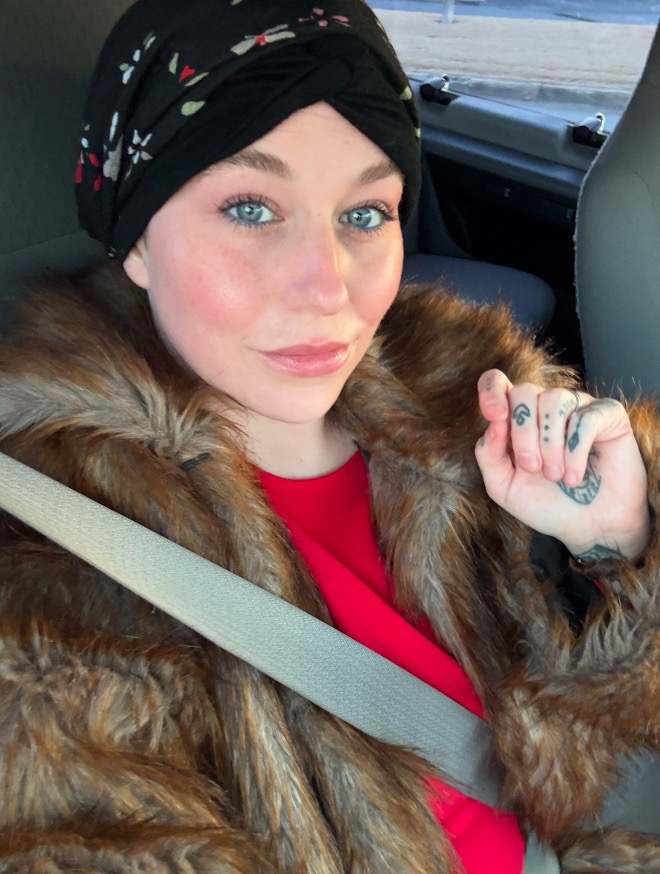
On October 30, 2024, Kira had the first part of her Deep Brain Stimulation (DBS) procedure. “Immediately, I saw improvement in my right hand,” she said. “I cried on the operating table as I watched a hand that I felt so disconnected with and so angry at show a steadiness that I hadn’t seen in decades. In the weeks that followed, the doctors and the team at Abbott dialed in my pulse generator and I saw further stillness. I continue to be in disbelief. I’ve noticed better balance, the head tremor is completely gone, and my body feels calmer in general. Friends and family that hug me say they can feel the difference through the embrace. My left side is scheduled [soon] and I honestly am counting down the days.”
Kira says her “wonderful family” carries her through the hard days. “My husband especially. He has fed me, dressed me, played guitar when I couldn’t and let me rest while he drove across multiple states to get to the next show. He has supported me in the best way which is just seeing me and hearing me. Understanding the ins and outs of what someone goes through with ET is unfathomable unless you are in the midst of it and he has handled every moment with strength and grace. He is a pillar of strength and I am beyond thankful to have him.”
As she continues to share her journey, she wishes more people knew that ET is not just shaky hands (or other extremities). “There are multiple non-motor effects that it can have on the body and mind,” she said. “I don’t even think I realized its impact until I had the DBS surgery. The relief I felt was overwhelming and I’m not even done yet. I wish people knew better that living in a body that you aren’t in control of can take its toll. The mental aspect alone of feeling disconnected to a part of you is heavy. The weight of ET is grandiose and the more people that know about it, the more knowledge that’s out there about it, the better off we’ll all be.”