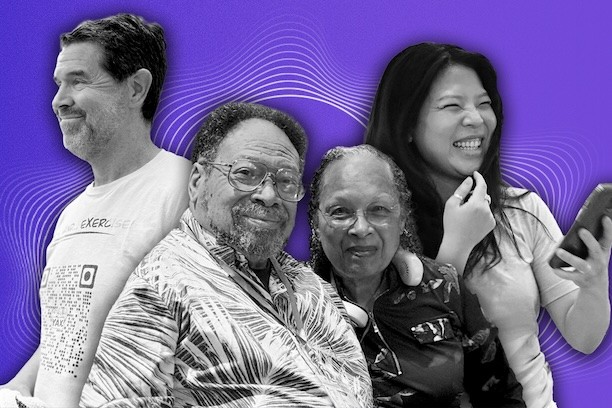
When Charlene Ostlund’s husband, John, was diagnosed with young onset Parkinson’s disease (YOPD) in 2000, he wanted to keep it a secret. He’s not the only one to choose this: living publicly with a progressive neurological disease, especially at a young age, can impact your career, your children, your social life. Many people opt not to say anything to protect themselves and their families.
For three years, John kept his disease hidden, not even telling family. But rather than seeing this as a form of protection, Charlene felt it as an added burden. “I couldn’t share what was happening with anyone,” she said. “It was hard on me; I worried.”
When I recently joined a Zoom call with Charlene and Debbie Twarogal, who are currently the President and President-Elect, respectively, of the Parkinson’s Support Group of Green Valley, Charlene immediately wanted to set the tone. Before I asked my first question, she told me she had been thinking about this quote: “Wellness is more than the absence of illness.” And when you’re living or loving someone with Parkinson’s disease, “wellness,” she insisted, “is more than treating symptoms.” Wellness is also community. It’s having people to lean on who get it. It’s doing your best to stay physically active.
After 24 years with Parkinson’s, John passed away last year. But Charlene remains committed to the support group because she remembers those early years when she felt lost and alone. “I remember how demanding being a caregiver is,” she said. “It’s a 24/7 job. And having Parkinson’s isn’t easy, either. Now I have the time to give. I’m going to give it.”
Today, the Parkinson’s Support Group of Green Valley, in southern Arizona, is robust, totaling 350 members. But it started as a fledgling group nearly 35 years ago in 1991, long before Charlene’s husband, John, or Debbie’s husband, Richard, were diagnosed. And long before Parkinson’s really entered the public’s awareness. As Debbie pointed out, the group formed seven years before Michael J Fox shocked the country with his young onset diagnosis, at age 29, and completely changed the look of Parkinson’s.
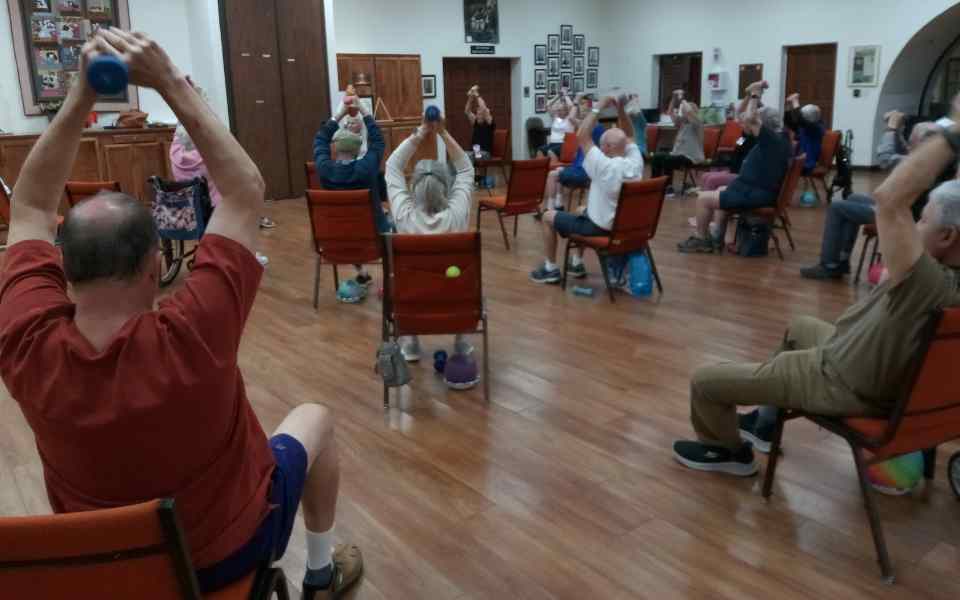
These days, the group’s slogan—Give Parkinson’s the SAC: Stay mentally STIMULATED, physically ACTIVE, and socially CONNECTED—speaks to what we know about living well with a movement disorder. Living well involves supporting people in their fullness, including care partners. To honor this commitment to give PD the SAC, the group’s calendar is bursting with activities: they have everything from lectures to exercise classes (boxing, chair workouts, golfing, pole walking, and more); as well as potlucks, birthday gatherings, book clubs, sing-a-longs, and watercolor painting.
Debbie, whose husband Richard has been living with Parkinson’s for over 20 years, believes the diversity of offerings helps meet people where they are. “Everyone’s needs are different. At the beginning, the support I needed was education. Even just borrowing books—we have a lending library. Everything I know about Parkinson’s came from the support group.”
But, over time, what became most important to Debbie and her husband wasn’t just the knowledge of how to live with the disease: it was who you do it with. The friendships they’ve formed in this group have been a balm on a rocky ride, offering the kind of understanding that you can only get from people who are living—and struggling with—something similar.
“I’ve noticed,” Debbie explained, “that one of the first things people say when they hear that our group exists is, ‘I don’t really need it. We’re good.’ It’s human nature. I have reached out to people who are afraid to acknowledge they might need some help. And they might not need the help right now. We’ve been in the group a long time; we didn’t need as much help back then as we do now. But a lot of our board are alums [care partners whose loved one has passed]. They stay involved because they grasp that passion and those friendships. We want to be able to provide the opportunity to get the support and resources they need.” For example, the group provides a list of doctors who specialize in movement disorders because when Debbie’s husband was first diagnosed, they were going to the wrong doctor who didn’t know how best to support them. “Just getting the right doctor was huge.”
“But the biggest thing,” Debbie emphasized, “is to develop relationships. Because when people form those relationships, we know they’re going to get the support they need.” with this disease.”
As care partners, Charlene and Debbie have found relief in being connected with others like them, which is something the group intentionally fosters. For example, at their monthly group sharing meetings, they reserve three rooms: one for people with Parkinson’s, one for care partners, and one for new members. This frees people to speak openly.
After John gave up driving, Charlene remembers being able to express her truth with other care partners: “I used to say all I wanted was some time home alone. Because unless I took John somewhere, he was always home.”
Debbie agreed. “I’m right in the thick of it,” she said. “It’s only been a few years since Richard hasn’t really driven and that’s exactly how I feel.”
Debbie went on, “I just saw a video of Michael J Fox with his wife, Tracy. He got wheeled up to a red carpet. The courage that took! He’s definitely being extremely affected by Parkinson’s, barely able to stand up, hold himself straight without moving. And I thought, how supportive she is. But I’m sure she has her moments.” Debbie knows because she’s living it, too.
“My experience,” Charlene said, “is you don’t want to talk to non-caregivers about it because they often think we’re being selfish. We’re not the ones with the disease, why are we complaining? The other care partners are the only ones who get it.”
Charlene and Debbie first met Sarah Jones, the founder of PMD Alliance, before she had even launched her organization. They immediately liked her. “Sarah is just an incredible person,” Charlene said. “Friendly and so eager to help. It was easy to connect with her.” When PMD Alliance officially launched into the world, the Green Valley group formed a natural kinship with them. “I remember busing people to their programs in Tucson,” Charlene said. In fact, PMD Alliance started using Zoom even before the pandemic, when Zoom was a foreign word for most people. The support group would invite their members to gather for group viewings of PMD Alliance’s online programs, ensuring that even those who didn’t know how to use Zoom had access.
When the Covid-19 pandemic struck, Charlene and Debbie’s group had to quickly pivot. To move their activities online, they relied on a free Zoom account provided by PMD Alliance.
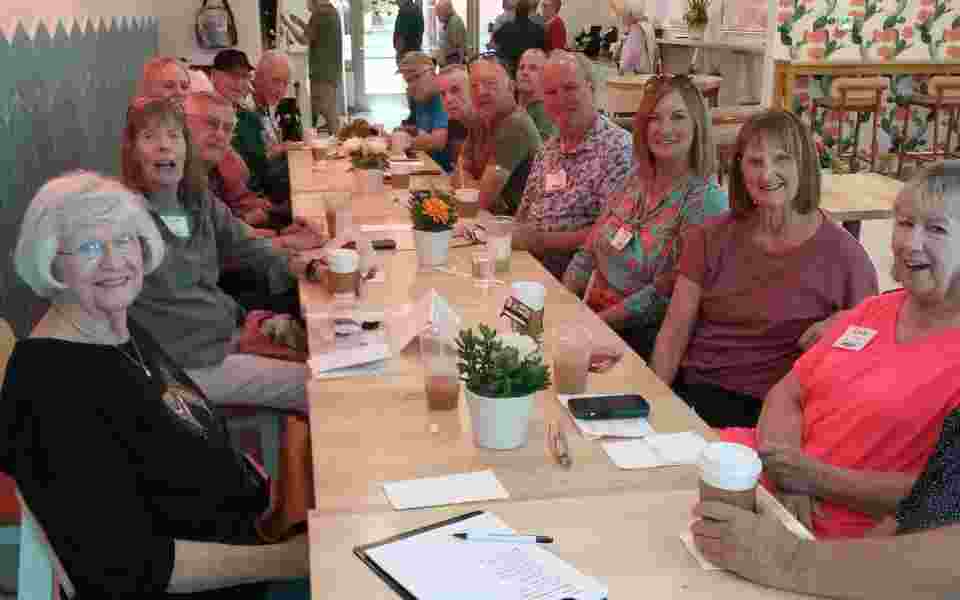
In the years since the pandemic, the group has returned to hosting in-person events. On Thursdays, they hold a coffee gathering at a local coffee shop. Charlene loves to see people with Parkinson’s mixing with care partners. “But sometimes,” she said, “there are people who will just come and enjoy their drink and not say a word. But they’re with us; they’re included.”
For Charlene and Debbie, this is what matters. The bedrock of PMD Alliance and of the Parkinson’s Support Group of Green Valley are the same: There is a place for you here.