

A few years after Tiffany Anderson was diagnosed with young onset Parkinson’s disease (YOPD), in 2021, it was consuming her life. Her medication was wearing off between doses, leaving her in pain. She had enrolled in a clinical trial, but one of the side effects of the trial medication was impulse control issues and she—someone who had never gambled before—slid into addiction, sneaking out of the house without telling her husband to go to the casino. The entire left side of her body was perpetually gripped in tension, her arm curled in. But most baffling was her mood. Tiffany lived for being with people but, in the years since her diagnosis, she felt disconnected. “I’d be out with friends,” she said, “and I was just tuned out, like I wasn’t there.” A full-time nurse and mom of two grown children, she had always been active. Now, she just wanted to “stay home, lay on the couch, and curl into a ball.” Something had to give.
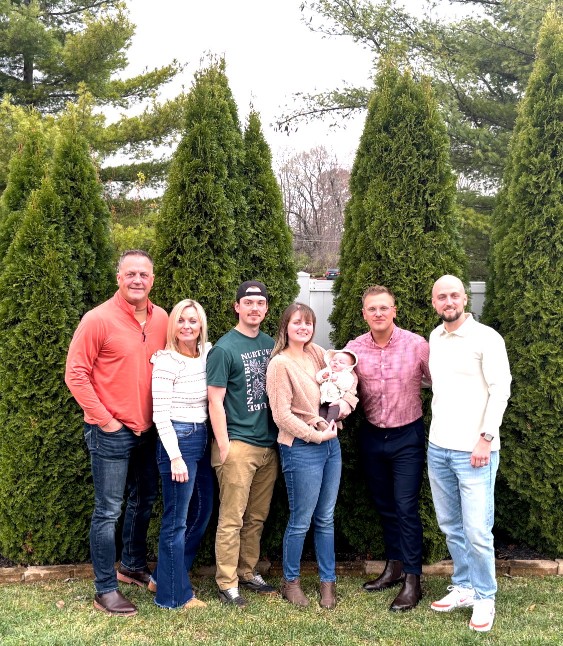
Her doctor suggested brain surgery—or deep brain stimulation (DBS).
Her husband’s first response was, “No way.” No one was going to cut into his wife’s head. But, the more they sat with it and the more they researched, the more they felt they had nothing to lose. On April 9, 2025, Tiffany underwent the first of two DBS surgeries. It would change her life.
When Tiffany started experiencing symptoms, before she was diagnosed with Parkinson’s, she couldn’t quite pinpoint what was wrong. “It was hard for me to explain what was going on,” she said, “I just knew something was off. I felt stiff. I was moving slowly. At one point, my mom even asked me if I hurt my neck because, by the way I was moving, it looked like I had a stiff neck.” But she never thought it could be Parkinson’s.
When her neurologist sat her down and delivered the news, she was shocked. “You’re telling me I have an old man’s disease?” she said. She was 47 years old. “I was thinking, ‘What is happening?’” She remembers leaving the doctor’s office and sobbing in the car. She called her mom, then her husband. Together, they cried for the rest of the day. They knew nothing about the disease or what their future held.
Preparing for deep brain stimulation surgery can feel daunting. There are many tests—physical and psychological—to determine whether you’re a candidate. Doctors recorded her walking, noting the way she swung her arms and watching her speed. They tested her memory and mental fitness. She had an MRI. With each test, she got another green light. Right before the first surgery, she had to shave her head. “It freaked me out a bit,” she said. (Today, nearly a year after surgery, she has a stylish pixie cut.)
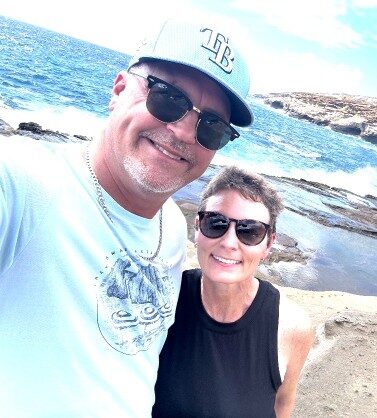
As a surgery nurse herself, she felt as level-headed as she could going into the procedure. “I wasn’t scared until the night before, and then it kicked in what was really going to happen. Up until that point, I was just excited about the possibilities of what the surgery could do for me,” she said. She knew her family was nervous: her husband, her kids, her parents. The day of, she tried to hold it together for them. But the minute the nurses rolled her down the hall in a wheelchair and she knew everyone was behind her, she cried.
Her biggest fear was being awake during the surgery. For Tiffany’s DBS procedure, she began the surgery asleep. In order to determine if the surgical team was targeting the right spots in the brain, the anesthesiologist woke her up mid-procedure to ask her questions. “I remember that part,” Tiffany said, “but I was so relaxed. They had so many medications on board. I didn’t care what they were doing. I was calm.” They asked her to move her hand, to move her feet, to confirm they were getting the results they wanted. “I’ve had a lot of surgeries—both shoulders, both knees, a hysterectomy, a C-section. This was probably the easiest surgery I’ve ever been through from a pain perspective.”
Two weeks after her first DBS procedure, she had the second (and final) surgery. She still remembers the first time they turned the device on. Her husband was filming it on his phone. Right before they flipped it on, the camera captured how tense she was, the whole left side of her body gripped in dystonia. “Then they turned it on,” she said, “and you could see my whole body just relax. I was like, ‘Oh, my gosh, this is incredible? Is this for real?’ Suddenly, I didn’t have the neck pain I was having for years.” When she and her husband got in the car to go home, they cried, this time with joy.
They couldn’t wait to share the results with their kids. They stopped off to visit their daughter at work. “As I walked in and she saw me,” Tiffany said, “she just started crying because she could see how different I looked.”
It wasn’t just her family who noticed. Tiffany has worked for the same company for 20 years; many of her colleagues have known her a long time. When she returned to work six weeks after her surgery, her colleagues couldn’t believe the shift in her: “It’s the old Tiff,” they said. “You’re back.” Until then, Tiffany hadn’t realized how much Parkinson’s had impacted her.
Tiffany wanted to pay it forward. A few months ago, she reached out to Medtronic, the company that created her DBS device, and asked to become an ambassador. Others who are considering DBS can reach out to her for a phone conversation. During the call, they can ask her anything they’d like about her experience with the procedure. She’s had a few calls so far, where prospective DBS candidates tend to ask first about what it’s like to have brain surgery. “Knowing somebody’s going to open your head for surgery,” Tiffany said, “they just want to know: Is it worth it?” They also like to hear about her recovery and medication routine after surgery. “The best thing that happened from that surgery,” Tiffany said, “is I was able to cut down on a lot of the medication I was taking, medication that was causing all my side effects.”
For Tiffany, being a Medtronic ambassador is a way to show up for her community. “Even though I had such a great support system, I would have benefitted from this help,” she said. “I didn’t know anyone with Parkinson’s. Before DBS, I just wanted to meet one person that was close to my age. Every person with Parkinson’s is different and experiences different symptoms, but if you can find just one person that has one symptom you’re experiencing, you feel that connection with them and it makes a huge difference.”
In fact, today, Tiffany is back to being a social butterfly. She’s had lunch with women from her Rock Steady Boxing class; she’s found connections with people near and far through social media. She met an older man with Parkinson’s who reminds her of her dad. “I call him my Parkinson’s dad,” she said. “We’ve formed such a close connection.” Her Parkinson’s dad and his wife have shared dinners with Tiffany and her husband. “I’ve met so many people with Parkinson’s,” she said, “that I never would have met prior who are just wonderful human beings.”
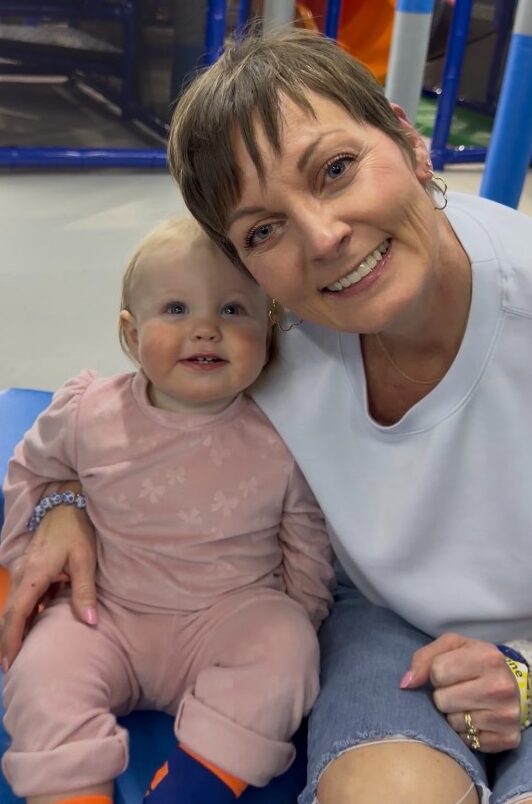
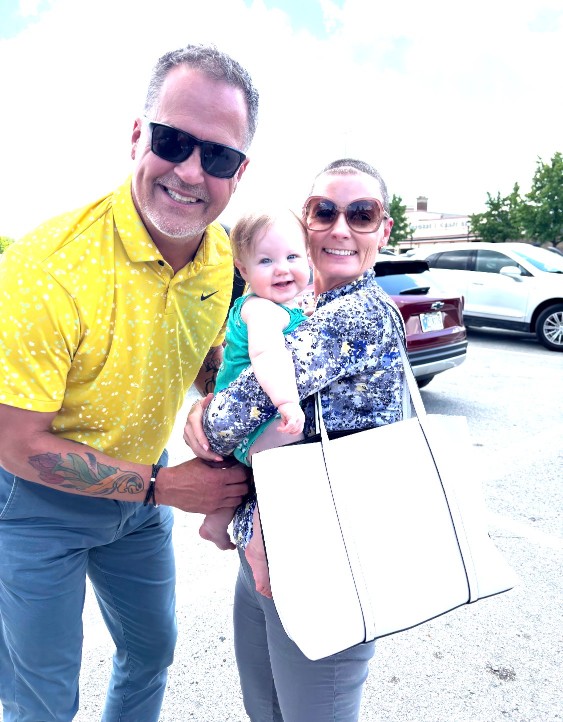
These days, Tiffany tries to “live every day the best that [she] can.” She’s savoring her new role as a grandma to her 16 month old granddaughter. And she’s eager to travel to Phoenix, AZ, for the World Parkinson’s Congress this fall. “My biggest message to anyone considering DBS,” she said, “is it’s definitely worth it. If you’re ready and you just want to keep living life and you’ve exhausted everything else, why not try it? I promise: it’s not as scary as it sounds.”