

“It shook me to my core.” When Wendy Sorem, a 46-year-old mom of four, was diagnosed with young onset Parkinson’s disease (YOPD), she slipped into depression. She had consulted “Dr. Google,” which sent her down a terrifying rabbit hole. “I crawled into bed,” she said, “and put the covers over my head. I thought my life was over.”
Even after she emerged from the initial darkness, shock lingered. “Who gets Parkinson’s at 46?” she wondered. All she knew about Parkinson’s was the stereotypical image of an old white man who shakes. “I’d never even heard of a woman getting it. Never women and never young women.” But here she was—at the pinnacle of midlife and all the fullness that comes with that: motherhood, career—navigating a new reality, alone. Where were all the other women like her? Did they even exist?
Wendy knew she needed to talk to someone. She searched online for a local Parkinson’s support group and found one specifically labeled “young onset.” When she saw that the group met at an assisted living facility, she thought that was odd, but didn’t let it stop her. “I took two steps into the room,” she said, “and it was full of men in their sixties, seventies, and eighties. There were no women except for care partners.” She tried to quickly back out of the room, but the group leader stopped her: “Are you Wendy?”
The men were sweet and she kept coming back, but the group still left a gaping hole for her. “They would bring in speakers that were all about retirement and social security, all these things that had nothing to do with me. I was still working. I had four kids in high school and college. I wasn’t in any of these categories they were talking about. I just knew: this wasn’t where I needed to be.”
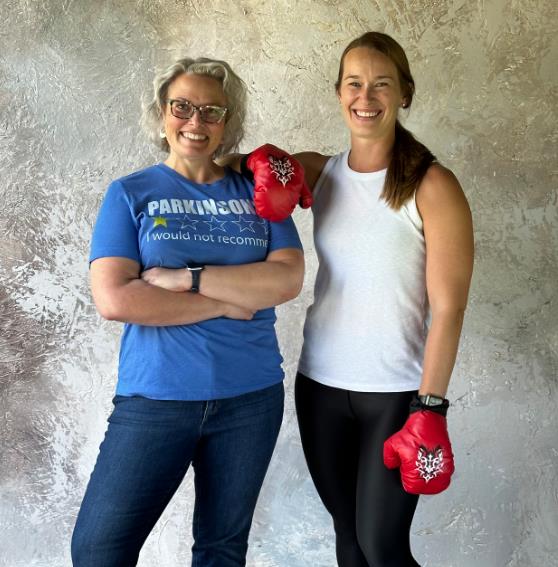
What do you do when the space you need doesn’t exist? At the time, Wendy’s doctor kept nudging her: “Start your own group.” “I can’t give you names,” she’d say, “but I have women who need a place to go, too.” They needed to find their people. During the support group meetings at the assisted living facility, Wendy met Calissa Schneider, ACSM EP-C, who would eventually become PMD Alliance’s Senior Manager of Certified Care.
“She’s a gem,” Wendy said about Calissa. They hit it off and decided to leap together: they put up flyers and started a Facebook group announcing the first meeting of a new support group: Young Onset PD in Women Wisconsin.
Just like that, women came out of the woodwork.
What Wendy wanted most was a safe community where she could ask other women: How are you dealing with this? She wanted to know: “How are you handling your kids? And your husband? What does your husband think?”
“When you get married, you say ‘for better or for worse, in sickness and in health,’” Wendy said. “And in that moment, you mean it. But when you’re diagnosed with a progressive disease like Parkinson’s—and so young—now you’re actually in it.” This was different, she said, from the sickness you think you’ll encounter when you’re in your 40s—back pain or a bad flu. “This is a weight,” she said. “This is heavy; this is the rest of our lives.”
Wendy couldn’t shake a sense of guilt. But she didn’t know how to talk about it, how to unearth the complex feelings she had around her diagnosis and the impact this disease would have on her partner. “I just kept thinking, ‘How do I let him off the hook if that’s what he needs?’ I had all these thoughts, but I kept them inside.”
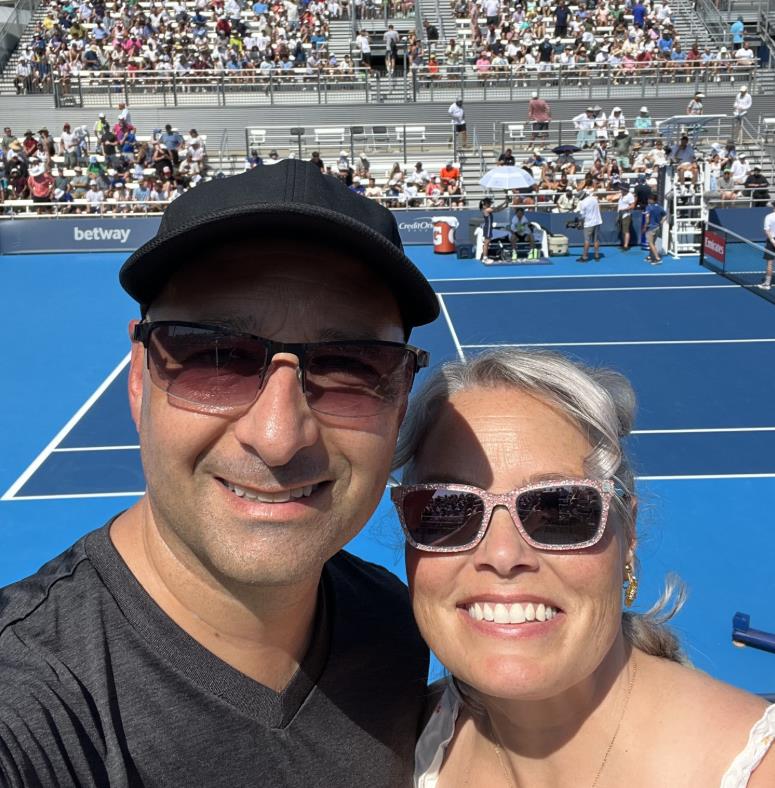
Slowly, she and her husband Mark realized that the only way to face this disease together was to talk about it. All of it. “I have to be able to tell him how I feel,” she said, “and he has to be able to ask me questions. If I’m in pain”—and maybe a little off or a little grumpy because of it—“he has to know that I’m not upset with him; we’re good. It’s just that my body’s not feeling well.”
By opening the lines of communication between them, Wendy has been able to release some guilt. “I’m extremely blessed that Mark didn’t blink. He was like, ‘I’m here. I’m in this. We’re going to do this together.’” She knows her story is not everyone’s. There are women in her support group whose husbands are not like Mark. “They’re quiet; they’re silent,” she said. “They don’t talk about what they feel. That means my friends are silent and quiet and don’t tell their husbands what they need. They’re struggling on their own because they know that, even if they say something, their husband won’t do anything.” For these women, the support group is a lifeline; it can’t replace the care and presence of a partner, but it is a safe landing spot, a place to be heard and seen and cared for.
Many of the women in Wendy’s group are in the midst of careers—careers they planned on living in and building on over the next couple of decades. “To stop working at this age at a job we love is really hard,” Wendy, who had been a middle school teacher, said. “Most of us have worked really hard to get to this place in our jobs.”
Wendy’s initial impulse was to pull back: she went from being a full-time teacher to a substitute teacher, allowing her to choose which days she would work. She still wanted to be around students, to be part of a workplace she loved. In fact, when she first considered applying for social security disability insurance (SSDI), she was reluctant. “I felt like SSDI is for people who can’t work at all. I’m not trying to play the system. I think there are a lot of people with young onset who don’t want to apply for social security because it will look like that.”
But the more she sat with it, the more she realized she was worthy of this supplemental support. “We have good days and we have bad days. We have days we won’t need any accommodations and days we need accommodations. But we can’t plan those. There are few good, full-time jobs that can meet those needs.”
Despite this truth, Wendy was denied benefits. This wasn’t a shock: many people told her to expect a denial on her first application. But the process revealed to her the cracks in the system—and how she can help inform others. She learned that the SSDI benefits are based on your last job, not the career you may have had for decades before that. In other words, if Wendy were to be approved for benefits, she would receive SSDI income based on her substitute teacher’s pay, not her previous long-term position as a full-time teacher. “Many of us choose to go part-time after our diagnosis because we want, still, to be there, to still be part of our careers, rather than leave it all together. But, financially, that’s not the way to do it.”
On the website for Wendy’s support group, she and Calissa made a conscious choice to repeatedly describe women with YOPD as “beautiful.” There are images of vivacious women laughing, of women gathering over coffee at a bookstore. There is fullness.
Certain symptoms of Parkinson’s are “very visible,” Wendy explained. “When I was first diagnosed, being a tremor dominant Parkinson’s woman, it could be embarrassing. It made me insecure and want to hide it. I know all the tricks for hiding my arms.” But Wendy has come to understand her wholeness and her beauty in a new light. “I want to remind women that Parkinson’s doesn’t change who you are. It changes your body, but it doesn’t change you. You’re beautiful regardless of what your body chooses to do. If you tremor, you’re still beautiful. If your body tenses up, you haven’t changed. Your body has changed. You’re still beautiful.”
Wendy has had to give up certain fashions: flip-flops in the summer or wedge heels. And there is grief in these losses; we feel changed. The way we dress can feel like part of who we are. “If we don’t have confidence [in our beauty, in our sense of self],” she said, “we’re not going to go out, we’re not going to be part of our community. We’re not going to meet with friends. We’re not going to live our lives.”
Our beauty, Wendy wants to remind women, is inherent. But it’s also important to find ways to feel our beauty, to feel that joy, to feel the rush of creativity that comes from our own unique expression of who we are. For Wendy, this has become her glasses. She has magnetic frame covers that she changes out daily. (The day we spoke, she was wearing funky turquoise frames to match her turquoise sweater. She was also rocking purple nails.) “Even if I’m staying in my jammies all day,” she said, “I will change my glasses to match my jammies. It’s what I do. Find something you love, that makes you happy or excited, and do it, even if it’s something little like glasses.”
It’s the little things that carry us through.
Studies have shown that women with Parkinson’s, especially young women, have significantly less social support and community than men. “This is because,” Wendy says, “young onset women spend most of their time taking care of their families, whether it’s their children or their husband or their parents.” In fact, women in midlife are considered the “sandwich generation,” sandwiched between caring for their kids and their aging parents.
Wendy believes that women as a whole, “whether you have a progressive disease or not, usually take care of themselves last…It’s easy for us to be diagnosed and, if it’s not a huge deal at first, to put it aside and be like, ‘Okay, I’ll deal with me when I can, but my kids still need me for this and I still need to take my mom to the grocery store. My life doesn’t stop because I got diagnosed.’”
But she wants to remind women: “Parkinson’s doesn’t allow you to put it aside forever. It shouldn’t allow you to do that. You need the support of other women who have Parkinson’s because we understand each other in a way that no one else does. Not even your spouse.”
Today, the women in Wendy’s group text each other almost daily; they laugh, they console, they provide advice, they simply express their feelings without judgment. They belong to each other.
“I think women need to know that it’s okay to have any and every emotion when they get this diagnosis. And if you’re really lucky, you get to find a group of women like we have and talk.” You get to process together.
We are not meant to walk through hard times alone. We need each other. Arms linked, we gain the fortitude to step forward.