

Bestselling author Sue Monk Kidd has spent her life telling stories. But when she was diagnosed with Parkinson’s in 2019, it was not the story she imagined for herself. Her father had died at 103 after a relatively healthy life; her mother at 99. She thought this would be her story, too: resilient, healthy, strong.
When a minor tremor appeared in her left hand in 2018, deep down she knew it could be serious, but she hoped it was just a nuisance—maybe too much caffeine? So when the movement disorder specialist at Duke University sat her down and said, “Sue, you have Parkinson’s disease,” she was stunned. When she stepped over the threshold from the doctor’s office into the hallway, she thought, “I’m stepping onto a new planet.” It was like “being thrust into a completely different world.”
It would take her three more years—and a descent into depression—to move through the waters of her grief and rekindle her life’s spark.
Sue and I spoke on a mild January morning in North Carolina. She was at her kitchen table, surrounded by paintings she had made in the wake of her diagnosis, with her dog Barney near her feet. “I’m home alone and I hope he doesn’t bark to be let out,” she said. (To his credit, he never made a peep.)
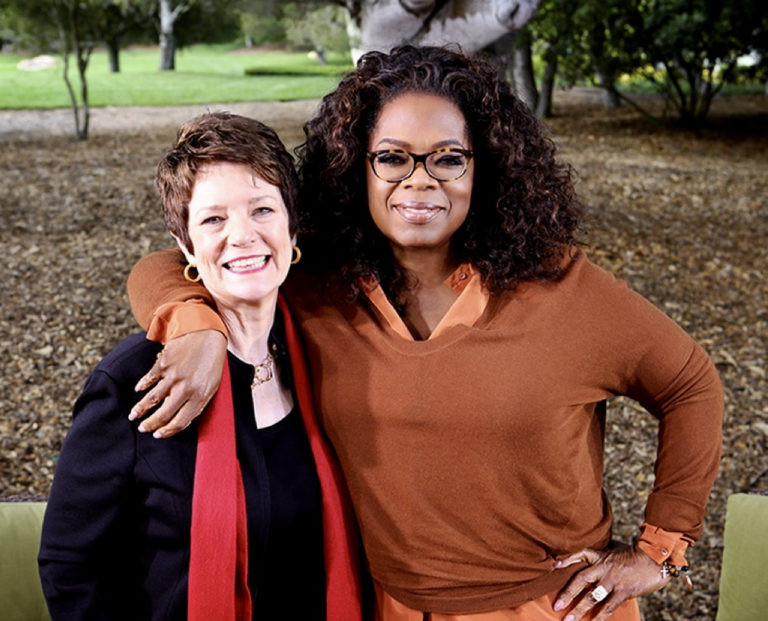
The previous October, Sue’s latest book, Writing, Creativity, and Soul, was released. Sue is no stranger to booming book launches: her first novel, The Secret Life of Bees, became an international phenomenon, selling more than 8 million copies worldwide. It was eventually adapted into an award-winning film. Her third novel, The Invention of Wings, achieved the holy grail: it was selected by Oprah for her book club.
For that novel, Sue spent three months on a 32-city book tour. But last fall, six years after her diagnosis as she prepared to launch her memoir on the “wellsprings of the inner life,” things looked different.
Parkinson’s had reared its head in the form of crushing fatigue and she had a choice: ignore her body or heed it.
Knowing when to push your body and when to protect its limits is tricky. “It isn’t easy for anyone with a chronic illness to understand where their balance is, their sweet spot,” Sue said. “And, when you do understand it, to stand by and guard it.” Sue wanted to show up for her book and for her readers. “You put this little love child you’ve created into the world,” she said, “and you want to support her, to be there. I yearned to do that, but I was also trying to be realistic about what was possible for me.”
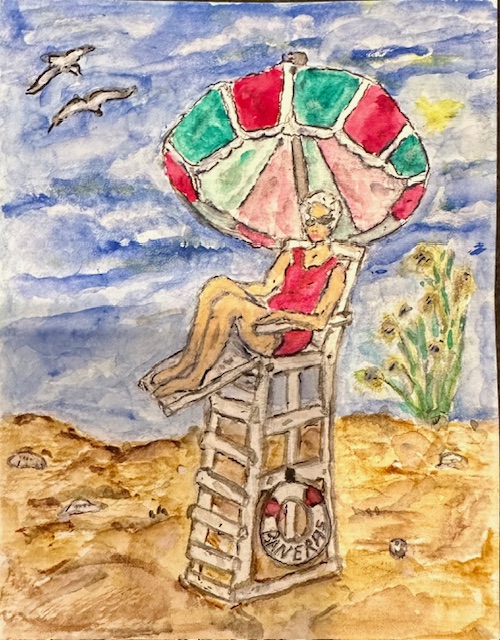
After Sue was diagnosed with Parkinson’s, she had a dream: in the dream, she was sitting on a lifeguard stand beneath an umbrella. She was guarding her life. When she woke, she knew what she had to do: try her best to understand and advocate for her boundaries.
When Writing, Creativity, and Soul was released, Sue chose to be her own lifeguard. With the understanding and support of her publishers, they arranged a handful of key interviews, but no travel. The book landed with acclaim. Even with new boundaries, her book became an instant bestseller.
In 2019, when Sue was diagnosed and was thrust onto a new planet, she didn’t have time to reckon with the new terrain. It was May and the novel she had been working on, The Book of Longings, was due in August. She still had to write the ending. She buried her head in work. By the time she looked up, COVID-19 had swept the globe and she dove into a virtual book tour of nearly 90 online events. It wasn’t until three years after her diagnosis, when the swirl of her work finally quieted, that depression came knocking.
By this time, her symptoms—once just a mild hand tremor—had amped up, becoming impossible to ignore. “I had to face it,” she said. She opened the door to the darkness and let it in.
Sue Monk Kidd was put on this planet to tell stories. Her books are audacious and engrossing and, for good reason, have garnered her millions of beloved fans. To an outsider, her creative spark seems inextinguishable. But the thing about chronic, life-changing illness is that it can unmoor you, stripping you of who you think you are. It can change your narrative. When depression hit, Sue felt bereft of light. “The creative spark,” she said, “which is the spark of life, had completely gone out. I didn’t think I could [create] ever again. I had no sense of meaning in this life.” She felt untethered from her soul.
Even in the pit, life rarely gives up on us; it continued to reach for her, to speak to her, including through the books she read. In the midst of reading the diaries of Holocaust victim Etty Hillesum, Sue was arrested by this message: “There are moments when I feel like giving up or giving in, but I soon rally again and do my duty as I see it: to keep the spark of life inside me ablaze.”
Sue copied down the quote. And she knew: “This is what I must do.” Throughout her life, Sue liked to draw “little sketches,” but she didn’t consider herself an artist and had never painted. But an impulse inside her called her to create, to reimagine her story through images. She called an art therapist.
“The greatest, strongest, deepest impulse in humans is toward wholeness,” Sue told me. “And I feel like we have to trust that. I decided to trust that it was there in me, somewhere. I had to find the creativity to bring forth a way to live on this new planet—and not just to live there, but to find meaning in it.” On the phone, she asked the art therapist, “I want to find my spark again. Can you help me?” The therapist replied, “I believe we can do this.”
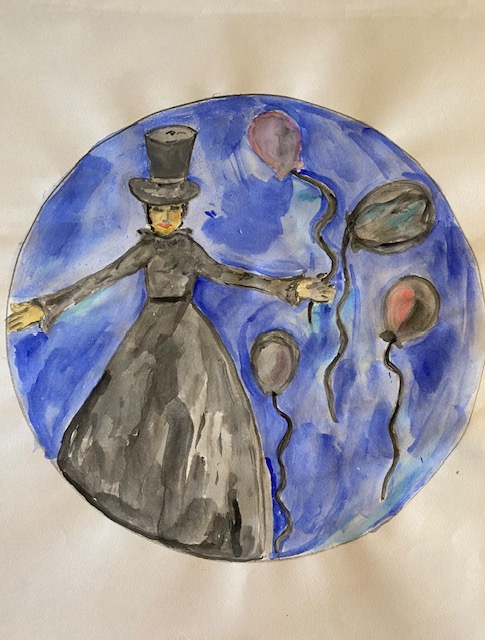
Every week for the next seven months, Sue painted, each image a little window into herself. One day, she painted a woman in a black top hat. The woman was releasing very dark balloons. On the back of the painting, Sue wrote that anxiety and depression were ballooning and she needed to let the air out, to let the wind take them and fly away.
In another, she painted herself alone, curled into the fetal position. On the back, she wrote,
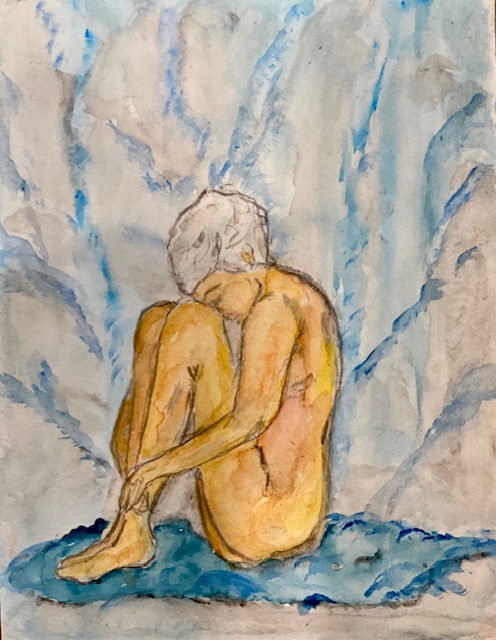
When you are alone and vulnerable, when you feel everything falling away, and there you are—exposed, when people stare at your tremor, when you stumble and your gait is awkward and clumsy, when your body won’t be still, when you are anxious and so very tired, when you don’t know how to make anyone understand the strangeness in your body—the rigidity, pain, and slowness—it will be OK; it really will. You are not the sum of your symptoms. Your vulnerability makes you human and beautiful.
With each painting, she was recreating her story. The more she painted, the more she navigated her central questions: How do I respond to my Parkinson’s? How do I make meaning out of it? How do I live alongside it? “I found that, in creating these images, I myself was recreated,” she said. “That’s what creativity does. It recreates us.”
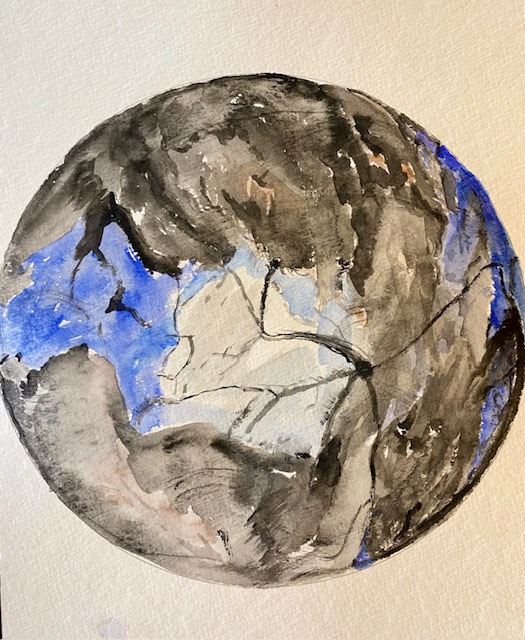
One day, she began to paint “a globe of this dark new world,” but in it, she added a patch of blue and white at the center. A sliver of hope.
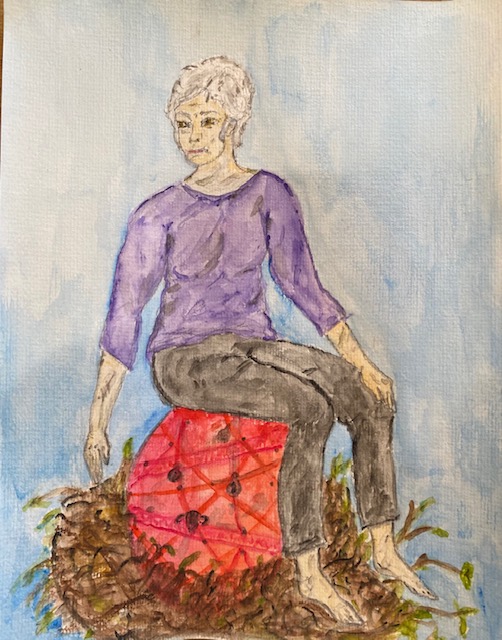
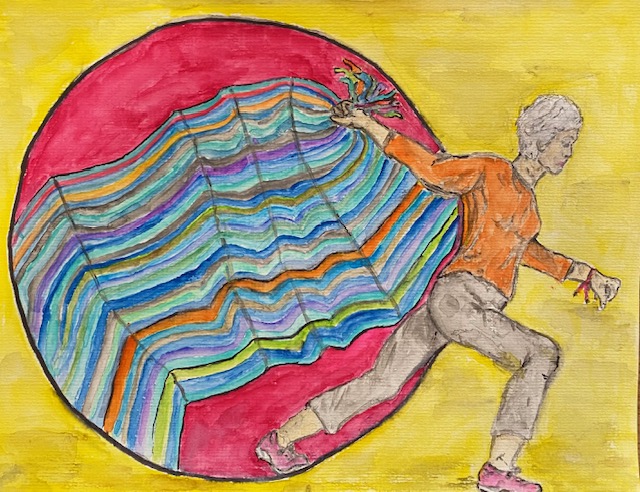
“Six and a half years after my diagnosis,” Sue said, “I think the core of me has found that place of peace and acceptance.” She describes her attitude like the Dag Hammarskjöld quote: “For all that has been, thanks. For all that shall be, yes.”
She admits that this is not a constant state; never perfect. “We are self-contradictory people,” she said. “There are days we feel it and days we don’t. But the core of us knows we can always return there.” In fact, she describes living with Parkinson’s as a paradox: “There’s this mystifying coexistence of joy and acceptance and peace and suffering and loss and grief. They’re always all-present, but typically we don’t feel them all at the same time.”
“Parkinson’s is a thief,” she said, laden with loss and limitation. But during the last few years—during what she calls “a renovation of my most self”—her view has expanded: What if, alongside grief and loss, something is gained?
When the writer Virginia Woolf was 42, she had a nervous breakdown. From her bed, she wrote a quintessential essay called, “On Being Ill.” Sue read me a quote from it: “In…sickness, how we go down into the pit of death and feel the waters of annihilation close above our heads and wake thinking to find ourselves in the presence of angels.” Chronic illness brings devastation, yes. But layered inside is something else: spiritual change.
Sue quickly admits that she says that carefully, “tremulously,” because when you’re in the midst of a depression or facing the shock of a diagnosis or the debilitating pain of your symptoms, you may not even want to hear somebody talk like that. She knows; she was there. But she also knows—because she has lived it—that illness can “awaken us.” “It causes the world to become alive,” she said. She described moments—like when a bird lands on the feeder in her yard and she watches it steadily, like a meditation—that “reframe [her] world.” “It’s the gift of attention,” she said. “I notice things more. It’s so beautiful to me now. I would never in a million years, when I was on a 32-city book tour and doing all of this lecturing and traveling and writing, have had that experience. In this way, we can say that illness can have a creative and liberating effect.”
In the midst of crushing fatigue and muscle pain—the kind of pain that seems to take over—Sue has found pockets of joy, micro joys. In these moments, gratitude spontaneously wells up inside her and she wonders: “If someone gave me the choice right now and said, ‘You can keep your Parkinson’s gifts or you can be perfectly normal like you were before, I would have a very hard time deciding. I probably would choose to be where I am now.”
For several years after her diagnosis, Sue was not ready to share it with the world. “I didn’t have the words yet,” she said. But when life swerved and went dark and she moved through art therapy, she found courage.
When she publicly disclosed her diagnosis, it initiated her into “another gift, into love.” As people began to reach out to her with compassion and with their own stories, she felt, “These are my people. I don’t know them, but I love them. They are a part of me, and I’m part of them…The love that people sent me, I wept almost every time I read it.” She went on, “I think love and compassion are as important in Parkinson’s as exercise. It’s healing.”
Sue hopes to write about this—the spirituality of illness. She’s been collecting notes. “But having a spiritual relationship to our illness, seeing meaning in it, doesn’t imply there’s passivity,” she said. “It doesn’t mean that I don’t fight this disease with every fiber of my being. I exercise five or six days a week. I do whatever I can to slow its progression. I’m not a fan of Parkinson’s.”
It’s complex. We must hold all of it—dark, light, shades of gray; devastation and awe; grief and growth; abandonment and grace—at once. This is how we rewrite our stories. This is how we kindle our spark.