

The first time Steve Yellen’s left hand tremored, he was lying in bed with his wife. It was March 2019. He had old injuries that caused nerve damage, and they figured it was just that. For a flash, his wife mentioned Parkinson’s, but she said it as a joke, dismissing it as a far-off possibility. It couldn’t be that. But by July of that year, his doctor had sent him to a neurologist, who delivered the shocking news: You have Parkinson’s.
Steve went to a series of doctors to confirm the diagnosis. Each one assured him that, while he did have Parkinson’s, it wouldn’t impact his lifespan. He relaxed into that assurance. “In retrospect,” he told me, “I think it made me a little more passive than I would have liked.”
As Steve began to learn more about the disease—including the power of exercise to slow progression—he realized he was missing an opportunity to reclaim a sense of agency over his journey. “For a period of time,” he wrote, “I focused on following medical advice, maintaining my routine and not projecting too far into the future. I believed I was managing Parkinson’s, but in reality, I was largely reacting to it.” He didn’t want to wait for his symptoms to get worse and, only then, to intervene; he wanted to take charge now.
This sent him down a rabbit hole—one that would change the way he lived. With each new discovery about living a full life with Parkinson’s, he felt a pull to share. He wanted to take the best—and most accessible—lifestyle tips for proactively managing Parkinson’s into the light. That’s when the seed of his newly released book, Living Parkinson’s, was born.
In researching his book, Steve spoke with scientists, doctors, and people living with the disease. In one interview, a man named Jeff shared his diagnosis story: he and his wife had been trying to get pregnant. Three days after they found out she was expecting, Jeff was diagnosed with Parkinson’s. Their stomachs dropped as their joy now mingled with fear. By the time his son was born, Jeff was walking with a cane and in a self-proclaimed “dreadful state.” Would he ever get to kick a soccer ball with his son? As grief enveloped him, he knew he needed a lifeline. His son’s arrival was the spark. Despite his cane, he began going to the gym. One year later, he completed his first triathlon. At the finish line, his son was waiting for him with a plastic trophy.
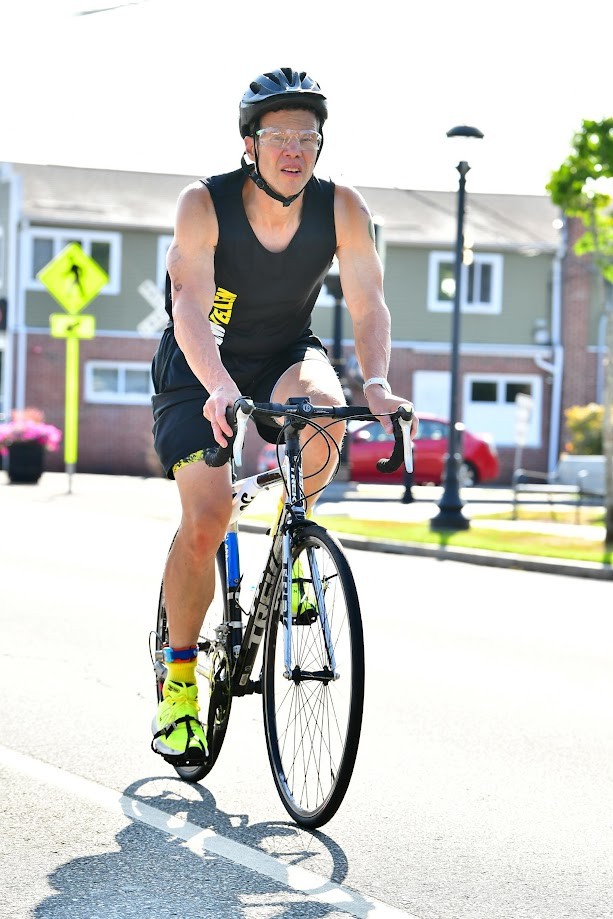
“That doesn’t mean you have to do a triathlon,” Steve said. You just need to find the thing that motivates you—your spark—and you need to start. “It doesn’t matter where you start,” he said, just that you do. “If, today, you can’t walk around the block,” that’s okay, Steve insists. “Set a small goal, maybe to walk to the corner and back.” When you do it, when you succeed, it’s like a mini adrenaline rush. “It’ll feel good,” he said. And that fans your flame. In fact, for Steve, who has completed 11 Spartan races, seven triathlons, and three races up the Empire State Building since being diagnosed, setting small, reachable goals has been pivotal. It’s all about taking one step and then the next—sometimes quite literally.
Attitude is one of the pillars of “living Parkinson’s” that Steve emphasizes in his book. When you change the way you see your disease, it changes the way you show up for it and for your life. To be clear, having a positive attitude does not mean denying reality. Steve wrote, attitude does not mean “forcing optimism or pretending Parkinson’s isn’t difficult. It means recognizing that how you respond to the diagnosis shapes what follows.” Early on, he tried to distance himself from his diagnosis, to think as little about Parkinson’s as possible and to simply carry on. It felt “protective,” he said—and we deserve to feel safe—“but, in practice, it led to avoidance. Avoidance didn’t stop progression; it simply delayed action.” Today, Steve is all about action.
“Shifting my attitude didn’t mean surrendering to Parkinson’s,” he writes. “It meant acknowledging it and choosing to engage. That shift reframed Parkinson’s from something happening to me into something I would actively address.” In fact, Steve is a proponent of the psychological paradigm “self-efficacy.” In essence, it’s your resilience, your belief that you can, to some degree, control your outcomes. You can enhance your self-efficacy, for example, by setting a series of goals. Each accomplishment bolsters your belief that you can achieve the next. Steve also likes to identify role models. For him, that may be people who have been living with Parkinson’s for 20 years and are still active and doing the things they love. Lastly, he finds fuel in positive reinforcement and encouragement from family and friends. When we surround ourselves with cheerleaders, with those who celebrate our small wins, we have the fire and the support to keep going.
It’s in this vein of kindling agency that Steve designed his book. “I have 35 callouts in the book with actionable takeaways: what you can do today. It’s everything from drinking water out of stainless steel or glass, rather than plastic, to setting up Google alerts for ‘Parkinson’s and constipation,’ or whatever is important to you.” In fact, he designed the entire book to feel welcoming and accessible. He studied book design and realized that some books have as many as 40 lines on a page. Steve insisted that his pages have a maximum of 32 lines. “I didn’t want more than two pages in the book without something breaking it up like an interview or a takeaway.”
Getting a Parkinson’s diagnosis can feel daunting enough; he wanted the advice he shares to be useful, not overwhelming. “As you flip through the book, I want you to look and think, ‘I can do this.’”
Every morning when Steve wakes up, he thinks about Parkinson’s. “A lot of people say, ‘Don’t let Parkinson’s define you,’” Steve said. “It’s a little controversial, but I’m the opposite. Parkinson’s is in me. It’s why I get up. If I don’t want to work out, I’m looking behind me thinking, ‘it’s gonna catch up.’ I use it as motivation.” As he spoke, he slowly unzipped his sweatshirt and raised the sleeve of his T-shirt to reveal a large red and green tulip tattoo on his upper arm, the symbol for Parkinson’s awareness. He has, quite literally, emblazoned his diagnosis on his body.
But it’s not the diagnosis he’s emblazoning so much as his fight. After seeing the effort Steve has put into fighting Parkinson’s, his daughter (who’s in her thirties now) said, “I’ve never seen anybody work so hard at anything in his life.” Steve said, “I want to show my kids what it means to not turn away from it.”
When we spoke, Steve, his wife, their four kids and significant others, were planning a trip to Florida, where several of them will do a Spartan race. Whether they’re racing or in the cheering squad, they’ll all be donning the “Team Yellen” shirts Steve designed. They fight Parkinson’s—and they live Parkinson’s—together.
As we closed our conversation, I asked Steve whether he feels he’s living his best life.
“I do,” he said. “And I’m not done. I’ve got momentum.”