

Laura Crawford had seen sloths on TV, but the first time she saw one in person, she felt a kinship. It was 2017 and she and her husband were visiting a sloth sanctuary in Costa Rica. “I felt such empathy,” she said, “that I got goosebumps. I thought, ‘That’s exactly how I feel!’” The information placard at the sanctuary described sloths as “bradypods,” which means “slow, tardy, or delayed limbs.” Laura, who had been diagnosed with early onset Parkinson’s disease three years earlier, recognized herself in its sluggish movement.
Her unexpected sense of familiarity with the sloth sparked a revelation: what if sloths could help her explain how it feels to live with Parkinson’s? This is how the Symptomary—a collection of personified symptoms with playful googly eyes—was born.
Before her Parkinson’s diagnosis, Laura’s life was full. She ran her own media relations company in Mexico City. Her clients included big companies like Merck and WalMart. “We traveled to clients,” she told me. “We sat at board meetings. We interviewed executives.” While her work was on track, something in her body felt off. She remembers crossing a busy avenue in Mexico City one day when, suddenly, she froze in the middle of the street. Unable to move in the heat of traffic, she felt frightened and embarrassed.
Then there was the nagging ache in her neck. Eventually, her business partner referred her to a surgeon, who operated, fusing four cervical discs. But a year after the surgery, she was “as stiff as ever.” Her face seemed less expressive, too, becoming mask-like. At lunch with her young interns one day, one of them turned to her and said, “Are you on drugs?” Laura was taken aback; she had never even smoked a cigarette. But her masked expression had come across as being drugged. It would take years—and three neurologists—for her to finally get a diagnosis: early onset Parkinson’s disease.
While Laura and I were talking on Zoom, her husband Dan walked into her office and greeted me with a big smile. He had just gone to the grocery store for Laura. When he left the room, Laura turned back to me: “What can I tell you? He’s wonderful. He’s supportive. He understands. He drives me everywhere. But it’s still hard.” She described Dan as the “executive type, prompt, and quick.” “He’ll tell me something in the supermarket,” she said, “and I don’t react right away because I’m slower now. He thinks I’m not paying attention. It’s hard to explain to him what’s happening inside me.”
Laura reached behind her and grabbed one of her puppet-like symptomary characters, called Slow Thought. It’s a brain on a snail. “Nobody else can understand what you’re feeling,” she said. “If they can’t get the motor symptoms, imagine the non-motor symptoms.” The symptomary characters are meant to foster understanding, to give shape to the abstract.
Slow Thought, the brain on a snail, is only one of Laura’s growing troupe of characters. There’s also:
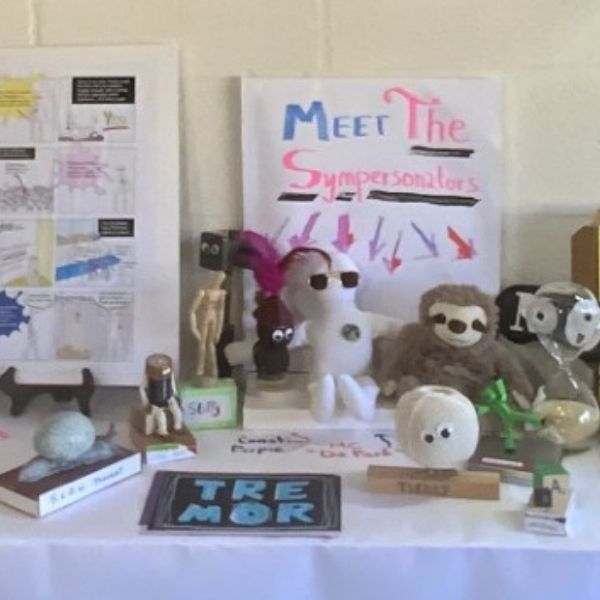
- Drippy, a faucet, that represents frequent and incomplete urination.
- Stiffy, an artist’s mannequin that moves rigidly.
- Tighty, a ball of yarn with googly eyes who is “all balled up.”
- And, everyone’s favorite, ConstiPoopie, a couple of golf balls inside a brown sock with a feathered hat, designed to represent constipation.
After Laura had visited the sloth sanctuary, she found herself collecting sloths: she wore socks decorated with sloths; she placed a stuffed, plushy sloth next to her bedside lamp; a sloth ring hugged her finger. “The sloths were so cute,” she said, “that conversation around the topic became easier.” It was a new insight. No one wants to talk about constipation. But when you add a funny feathered hat to ConstiPoopie or googly eyes to a ball of yarn, taboo symptoms become “approachable and friendly.”
In 2023, Laura officially launched the Symptomary at the World Parkinson’s Congress in Barcelona. PMD Alliance sponsored the endeavor, ushering it into the world—because talking about unpleasant symptoms matters. Frequently, Laura will pack up her troupe of symptomary characters, or as she teasingly calls it, “the kids,” and take them to a 55+ community—which includes many people who do not have a Parkinson’s diagnosis or who don’t even have Parkinson’s (PD) on their radar.
“We have a tidal wave of Parkinson’s patients coming,” Laura said, referring to the growing epidemic of PD. “And, if you haven’t noticed, there’s not enough doctors.” At the moment, there are over one million people in the United States living with Parkinson’s, but only about 600 movement disorder specialists, the expert doctors who concentrate on the disease. This means that many people are going to their primary care doctors or general neurologists with unusual sets of motor and nonmotor symptoms—and these providers are not equipped to recognize and quickly diagnose the disease from such a diverse array of symptoms. If patients feel uncomfortable talking about their symptoms, or don’t recognize them, it may take years for them to get a proper diagnosis.
When Laura speaks to groups, she often brings a glass that’s one-third full. “By the time you have symptoms, you have only one third of your dopamine left,” she said. “Your brain is already depleted. The mission of the symptomary is to achieve earlier diagnosis by showing people what Parkinson’s symptoms are. People think that only old people who shake have Parkinson’s, and that’s just not true.”
Last year, Laura’s beloved cat died. “I had a hard time with it,” she said. So she decided to add another character to the troupe, the “It’s Life Support Group,” a tissue box that says, “Sad shit happens. Together we can give it a positive spin.” With Parkinson’s, she explained, “you can either despair or choose joy. You can choose anger or you can choose kindness.” This doesn’t mean you have to be positive in every moment; Laura feels deeply the heaviness of living with this disease, too. In fact, her advocacy has buoyed her, connecting her to a loving and supportive community. But it has also connected her to their pain.“I have a friend with PSP, Parkinson’s on steroids. And she’s going down quickly,” Laura said. “Now, I can hardly understand her. I suffer along with her. It breaks my heart.”
This, she said, is life—unavoidable. But even in the nadir, we have a choice. We can choose a positive spin. “Even if it’s very slight, it might make a huge difference.”
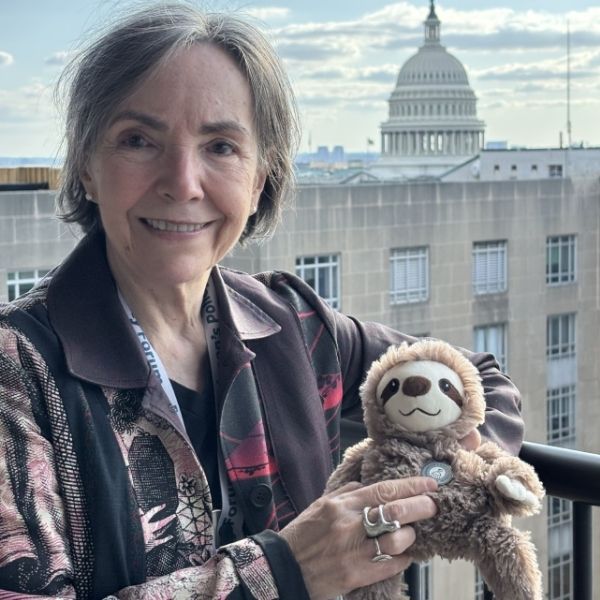
At the end of our conversation, we drifted into talking about life’s meaning. “Life can be brutal,” she said. In the face of it, she holds steadfastly to humor, allowing light and dark to exist side by side. She showed me a binder of important documents she had gathered for after her death. On the cover, she had written: “Documents for when I croak.” Below that: “To be opened on: Date Unknown (because I’m not a psychic).”
She laughed. Then, turning serious, her voice breaking, she said, “We’re all in this thing called life. It’s hard. Brutal. I’m here to make the way easier for other people. Because the meaning of life? It’s simple. Just be kind.”